
Pakistan’s Power Market Transition to a Competitive System
Mian Iftikhar Ahmad
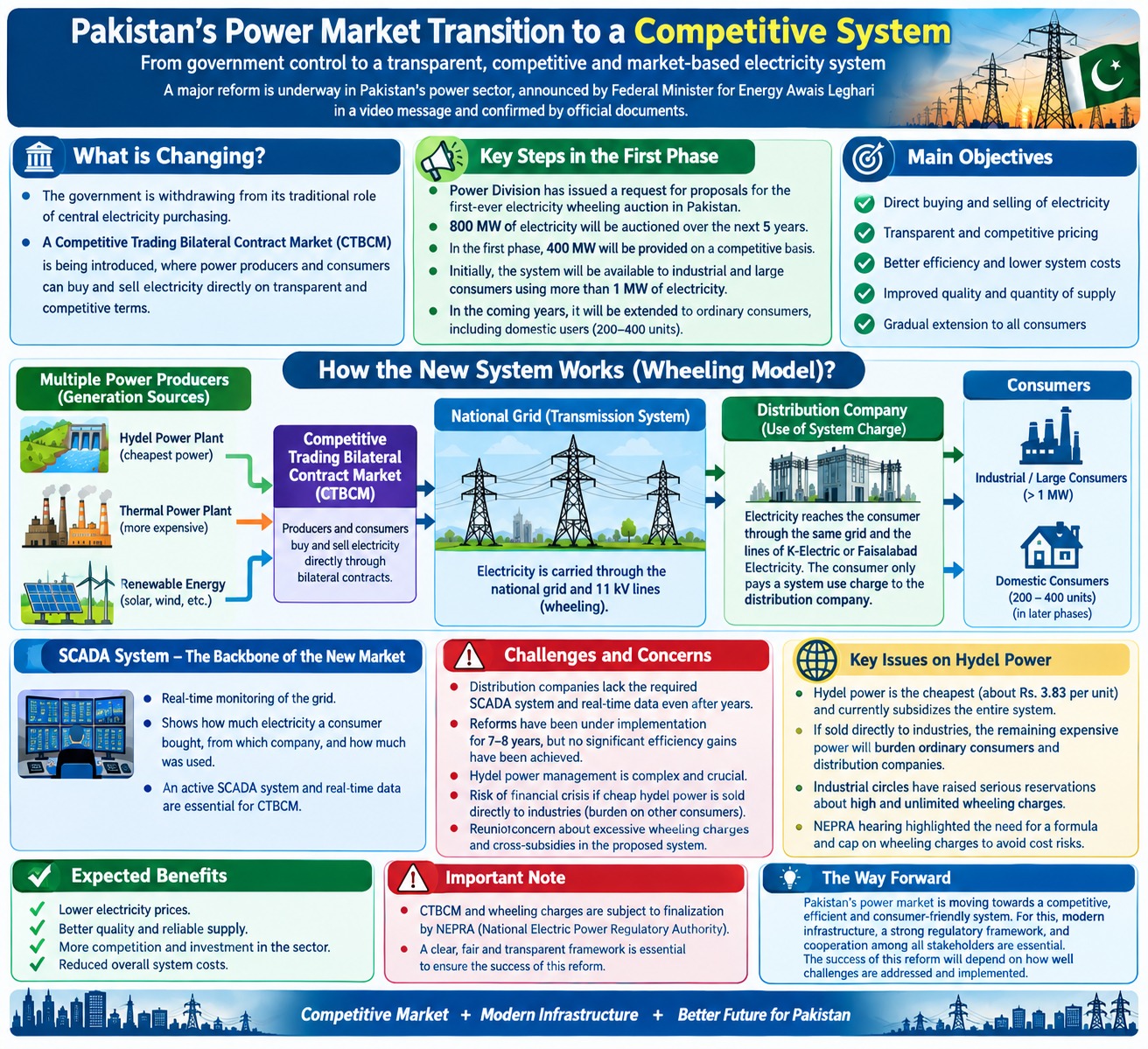
A historic change is taking place in Pakistan’s power market, the announcement of which was made by Federal Minister for Energy Awais Leghari in a video message and which is also confirmed by official documents. Under this new system, the government is withdrawing from its traditional role of central electricity purchasing and a competitive trading bilateral contract market known as CTBCM is being introduced, the basic objective of which is to make direct buying and selling between power producers and consumers possible on transparent and competitive grounds. In this regard, the Power Division has issued a request for proposals for the first ever electricity wheeling auction in Pakistan’s history, under which a total of eight hundred megawatts of electricity is planned to be auctioned over the next five years and in the first phase four hundred megawatts of electricity will be provided on a competitive basis. This system will begin first with those industrial or large consumers who use more than one megawatt of electricity and in the coming years its scope will be extended to ordinary consumers, including domestic consumers who use two hundred or four hundred units.
Under this new system, the basic infrastructure of electricity transmission and distribution, namely grid stations and eleven kilovolt lines, will remain common and this system works on the principle of wheeling, which means that an industrial consumer can buy electricity from a distant cheap power plant and that electricity will reach this consumer through the same national grid and the lines of K-Electric or Faisalabad Electric, and this consumer will only have to pay a use of system charge to its distribution company so that it can use their system for the transmission of electricity. This means that in the same area there will be lines of only one company but the consumer will have the option of choosing from whom it wants to buy electricity and for this there will be no need to build separate physical distribution systems but this separation will be established at a commercial and contractual level. For the implementation of this system, a modern SCADA system and real time online data are required so that it can be determined how much electricity a consumer bought from which company and how much it used. The Sustainable Development Policy Institute, namely SDPI, organized an energy regulatory sandbox in which experts made clear that the basic operational infrastructure required for CTBCM, including an active SCADA system and real time data, is not available at the level of distribution companies even after years and although work has been going on these reforms for about seven to eight years, no significant efficiency gain has been achieved so far. Former Managing Director of the Private Power and Infrastructure Board Shah Jahan Mirza termed CTBCM an important subject of the sector and said that at present it is working as a limited competitive market and the quantity being auctioned is not large in terms of volume, therefore its overall impact may be limited. Referring to international experience, he said that in markets opened for competition, generally improvement has been seen in electricity prices, quality and quantity and reducing the overall system costs should be the basic objective, which can be managed through revenue from wheeling charges and recovery of standard cost from migrated consumers so that the rest of the system does not suffer any negative impact.

Regarding hydel power, the power houses that run on water and whose cost is the cheapest, their management is the most complex and important question of this new system, on which think tanks and experts are expressing concern. In Pakistan, hydel power produces the cheapest electricity whose tariff is about three rupees eighty three paisa per unit while it provides subsidy to the entire system. In this new system, if the cheap hydel power houses start selling electricity directly to industries, a major financial crisis can arise because the burden of the remaining expensive electricity will fall on those ordinary consumers and distribution companies who will not be able to use this cheap alternative. Before the National Electric Power Regulatory Authority, namely NEPRA, in a hearing regarding uniform use of system charges, industrial circles expressed serious reservations that the proposed charges are excessive and include an element of cross subsidy which is unrelated to the actual cost of transmission and distribution. The representative of the Federation of Pakistan Chambers of Commerce and Industry pointed out that in the existing framework there is no limit or formula on wheeling charges, due to which market participants can be exposed to unlimited cost risk, and they warned that if these charges approach three point five cents per unit, they will be unacceptable to industry and can make the CTBCM framework unworkable.
Regarding the choice available to ordinary consumers, the situation is that at present this system is only for large industrial and commercial consumers who use more than one megawatt of electricity and ordinary domestic consumers are not being given any choice yet, however the government says that in the coming years its scope will be extended to ordinary consumers as well so that they too can buy electricity according to their choice. Under this system, there is no mention in official documents or available reports of selling dams or WAPDA power houses; the purpose of this new system is the restructuring of the power sector, not the sale of national assets. Regarding the reaction of Pakistani political parties, available information is limited. The election manifesto of the Awami National Party talks about solving the electricity problem at the root and it has emphasized the development of on grid solar farms, wind farms and small dams on rivers as alternative sources. This party’s position is that the rights of distribution, division and operation of electricity should be provincial and that direct foreign investment should be sought to harness Pakistan’s hydel power generation capacity. However, the detailed reaction of major national parties such as Pakistan Muslim League Nawaz, Pakistan Peoples Party and Pakistan Tehreek-e-Insaf on this specific policy is not available.
The official position of the government is that this system is an important step towards converting Pakistan’s power sector from a single buyer model to a competitive market and through it industries will get access to electricity at competitive rates, which will reduce production costs, improve competitiveness in international markets and increase exports. The Minister for Energy also said that at present there is a surplus of about seven thousand megawatts of electricity in Pakistan and a proposal has been made to provide this additional electricity to industries at a nominal rate, which can make it the cheapest industrial electricity in the region. The World Bank has endorsed this point of view and said that using surplus electricity at marginal cost is far better than letting it go to waste. The Minister for Energy also said that in winter electricity was already being provided at these low rates without any subsidy and now the target is to extend this model throughout the year. The success of this system depends on how the government strengthens the technical framework and how it maintains financial balance so that ordinary consumers do not face any further burden. SDPI’s sandbox report has recommended that a virtual power plant lead revenue model be established for distribution companies, participation in the auction be phased and a CTBCM surplus market mechanism be created from which an estimated revenue of about ninety three billion rupees is expected. Muhammad Faisal Sharif, an energy and climate practitioner at the University of Bath, said that CTBCM provides a favorable environment through relevant authorities and institutions and the country is finally entering a competitive mode through the privatization of distribution companies, but he stressed that this debate needs to go beyond just the concerns of DISCO revenues and see how marginalized communities and the rural population will benefit from this transition. Amina Shahab, Research Associate at the Policy Research Institute for Equitable Development, expressed concern over the reliability of electricity supply for industrialists and investors and said that uninterrupted electricity is necessary for uninterrupted production and many industrial consumers are already relying on multiple energy sources including captive solar, wind and thermal generation, and the question is whether the initial phases of CTBCM will be successful or not unless the readiness of consumers and the need for reliable supply is properly assessed.
Under this system, a market for electricity will be created from which the consumer will be able to buy the cheapest electricity for itself and the government will get out of the hassle of first buying electricity and then forcibly providing it to you at its fixed rate, however this is just the first step and in the coming years the benefits of this system will reach ordinary consumers. In addition, the government has claimed savings of three point five trillion rupees over the lifetime from renegotiations with IPPs, forty seven billion rupees from the sale of excess machinery of state owned generation companies, and one hundred ninety three billion rupees from the reduction of losses of distribution companies. The national average electricity price has fallen from fifty three rupees four paisa per unit between March two thousand twenty four and May two thousand twenty six to forty two rupees twenty six paisa per unit, which is a twenty percent decrease. The industrial tariff has fallen from sixty two rupees ninety nine paisa to forty two rupees forty paisa per unit. Regarding this system, it is clear that it is a trial and phased process which is currently limited to large consumers only and its success depends on how the government strengthens the technical framework and how it maintains financial balance so that ordinary consumers do not face any further burden. The points you have raised are absolutely correct and these are the same challenges which experts of Pakistan’s energy sector are also considering.
